A Seat at
Their Table
A Seat at Their Table
A Seat at Their Table
What happens when the world forgets to make room for you.
A Meta Quest 2 experience that places you in the shoes of someone with a peanut allergy at a dinner party. The food looks good. None of it is safe.
What happens when the world forgets to make room for you.
A Meta Quest 2 experience that places you in the shoes of someone with a peanut allergy at a dinner party. The food looks good. None of it is safe.
What happens when the world forgets to make room for you.
A Meta Quest 2 experience that places you in the shoes of someone with a peanut allergy at a dinner party. The food looks good. None of it is safe.
Role
Role
Role
Solo: concept, narrative design, environment build,
interaction design, prototyping
Solo: concept, narrative design, environment build, interaction design, prototyping
Solo: concept, material design, resin casting, print design, assembly
Context
Context
Context
Experimental XR, CCA MFA Design
Fall 2024
Experimental XR, CCA MFA Design
Fall 2024
Hybrid Business Practice
CCA MFA Design, Spring 2025
Type
Type
Type
VR empathy experience, single-player, Meta Quest 2
VR empathy experience, single-player,
Meta Quest 2
Physical product, edition of 12
3 sold at $60 each
Tools
Tools
Tools
Unity, XR Interaction Toolkit, C#, spatial audio
Unity, XR Interaction Toolkit, C#, spatial audio
Unity, XR Interaction Toolkit,
C#, spatial audio
THE BRIEF
THE BRIEF
Build empathy by putting people inside it
Build empathy by putting people inside it
Build empathy by putting people inside it
Some experiences only land when you feel them yourself. The right VR scenario can put a user inside someone else's stigma and build empathy that an article or a statistic can't.
That's the premise behind Empathy Machine, a VR project: embody the user as someone who carries a social stigma, then build a scenario that makes that bias impossible to ignore.
I've been lactose intolerant for over nine years. I know what it's like to sit at a table where almost nothing is safe to eat, to explain it twice, and to watch someone's face decide whether to take it seriously, and then still go home hungry.
Some experiences only land when you feel them yourself. The right VR scenario can put a user inside someone else's stigma and build empathy that an article or a statistic can't.
That's the premise behind Empathy Machine, a VR project: embody the user as someone who carries a social stigma, then build a scenario that makes that bias impossible to ignore.
I've been lactose intolerant for over nine years. I know what it's like to sit at a table where almost nothing is safe to eat, to explain it twice, and to watch someone's face decide whether to take it seriously, and then still go home hungry.
THE DECISION THAT SHAPED THE PROJECT
THE DECISION THAT SHAPED THE PROJECT
The condition I tested wasn't the one I shipped
The condition I tested wasn't the one I shipped
The condition I tested wasn't the one I shipped
My first storyboard embodied the user as someone with lactose intolerance. Classmates read it as a minor inconvenience. The risk underneath it didn't register, even though the dismissiveness in the dialogue felt true to my life.
So I kept the story and changed the embodied condition. Same dinner party, same dismissive host and guests, same arc, but with peanuts: common, widely understood as life-threatening, where that same dismissiveness suddenly reads as wrong.
My first storyboard embodied the user as someone with lactose intolerance. Classmates read it as a minor inconvenience. The risk underneath it didn't register, even though the dismissiveness in the dialogue felt true to my life.
So I kept the story and changed the embodied condition. Same dinner party, same dismissive host and guests, same arc, but with peanuts: common, widely understood as life-threatening, where that same dismissiveness suddenly reads as wrong.
TESTED WITH PEERS, THEN CHANGED
TESTED WITH PEERS,
THEN CHANGED
Same scenario, different stakes
Same scenario, different stakes
Drawn directly from my own experience. Honest, but the storyboard read as a minor inconvenience to classmates who hadn't lived it. The empathy gap stayed open.
Drawn directly from my own experience. Honest, but the storyboard read as a minor inconvenience to classmates who hadn't lived it. The empathy gap stayed open.
First version: lactose intolerance
A condition with broader, immediate legibility: most people already understand peanut allergies as serious. The same dismissiveness now reads as a real risk.
A condition with broader, immediate legibility: most people already understand peanut allergies as serious. The same dismissiveness now reads as a real risk.
Final version: peanut allergy
The feeling I wanted to transmit didn't change. What people were willing to take seriously did.
The feeling I wanted to transmit didn't change. What people were willing to take seriously did.
NAMING THE TARGET
NAMING THE TARGET
Who this was built for
Who this was built for
Who this was built for
The project began with an empathy target statement: who it's for, and what it should change in them. Writing it forced a commitment to outcome before a single scene was built.
The project began with an empathy target statement: who it's for, and what it should change in them. Writing it forced a commitment to outcome before a single scene was built.
EMPATHY TARGET STATEMENT
EMPATHY TARGET STATEMENT
I'm using VR to build empathy for individuals with food hypersensitivities.
This experience places users in the shoes of someone with a peanut allergy at a dinner party where their dietary needs are overlooked.
By making the user feel embarrassed, pressured, and isolated as they repeatedly explain their allergy and face judgment from the host and guests, the user's empathy for those who live with food hypersensitivities will increase.
I'm using VR to build empathy for individuals with food hypersensitivities.
This experience places users in the shoes of someone with a peanut allergy at a dinner party where their dietary needs are overlooked.
By making the user feel embarrassed, pressured, and isolated as they repeatedly explain their allergy and face judgment from the host and guests, the user's empathy for those who live with food hypersensitivities will increase.
STRUCTURE
STRUCTURE
Five scenes, one evening
Five scenes, one evening
Five scenes, one evening
The experience runs a fixed five-scene arc: onboarding, entering the house, seated at the table, discovering the food is unsafe, returning to the entrance. Each scene was storyboarded with dialogue, environment, and user agency before any of it was built in Unity.
The experience runs a fixed five-scene arc: onboarding, entering the house, seated at the table, discovering the food is unsafe, returning to the entrance. Each scene was storyboarded with dialogue, environment, and user agency before any of it was built in Unity.

The five-scene storyboard for A Seat at Their Table, showing dialogue, environment notes, and user agency for each scene.
The five-scene storyboard for A Seat at Their Table, showing dialogue, environment notes, and user agency for each scene.
The core interaction happens in Scene 3: hovering over a dish surfaces a warning that it contains an allergen. No dish is actually safe. The mechanic isn't a puzzle, it's a closed loop, the search itself is the point.
The core interaction happens in Scene 3: hovering over a dish surfaces a warning that it contains an allergen. No dish is actually safe. The mechanic isn't a puzzle, it's a closed loop, the search itself is the point.
The interaction at the center of the experience happens in Scene 3. The user hovers over each dish on the table to plate food, and each hover surfaces a warning: the dish contains an allergen. There's no dish that's actually safe. The mechanic isn't a puzzle to solve, it's a closed loop that makes the search itself
the point.

In-headset view of the hover warning rendered over the Shrimp Gyoza. Every dish came from a kitchen with peanut cross-contact, so nothing on the table was actually safe.
THE BUILD
THE BUILD
Easy where I expected hard, hard where I expected easy
Easy where I expected hard, hard where I expected easy
Easy where I expected hard, hard where I expected easy
Movement uses smooth locomotion through the entry scene in the living room. Once the user reaches the dining room, they're seated automatically alongside the other guests, matching everyone else at the table.
Collision was the part I assumed would be the obstacle. It wasn't. Box colliders, letting the user's hand interact with the living room chairs, walls, and other objects, turned out to be some of the easiest work in the build.
The hover-and-warn interaction on the dining table was the opposite. Getting a raycast hover to surface a warning per dish, then clear it, took far more effort than the physics did.
How it actually worked
ChatGPT walked me toward custom scripting: interaction layer masks, manually wired raycast logic, more code than the mechanic needed. It kept looping back to the same broken first step instead of resolving it.
My professor, Scott Minneman, had a simpler fix: the XR Interaction Toolkit's built-in raycast-selectable behavior, where a canvas pops up and disappears automatically as the ray enters and leaves each object. No scripting required.
Movement uses smooth locomotion through the entry scene in the living room. Once the user reaches the dining room, they're seated automatically alongside the other guests, matching everyone else at the table.
Collision was the part I assumed would be the obstacle. It wasn't. Box colliders, letting the user's hand interact with the living room chairs, walls, and other objects, turned out to be some of the easiest work in the build.
The hover-and-warn interaction on the dining table was the opposite. Getting a raycast hover to surface a warning per dish, then clear it, took far more effort than the physics did.
How it actually worked
ChatGPT walked me toward custom scripting: interaction layer masks, manually wired raycast logic, more code than the mechanic needed. It kept looping back to the same broken first step instead of resolving it.
My professor, Scott Minneman, had a simpler fix: the XR Interaction Toolkit's built-in raycast-selectable behavior, where a canvas pops up and disappears automatically as the ray enters and leaves each object. No scripting required.

Unity hierarchy showing a Warning object nested under the Pad Thai dish, with its Plane Mesh Filter, Mesh Renderer, and Mesh Collider set to the Food layer in the Inspector.
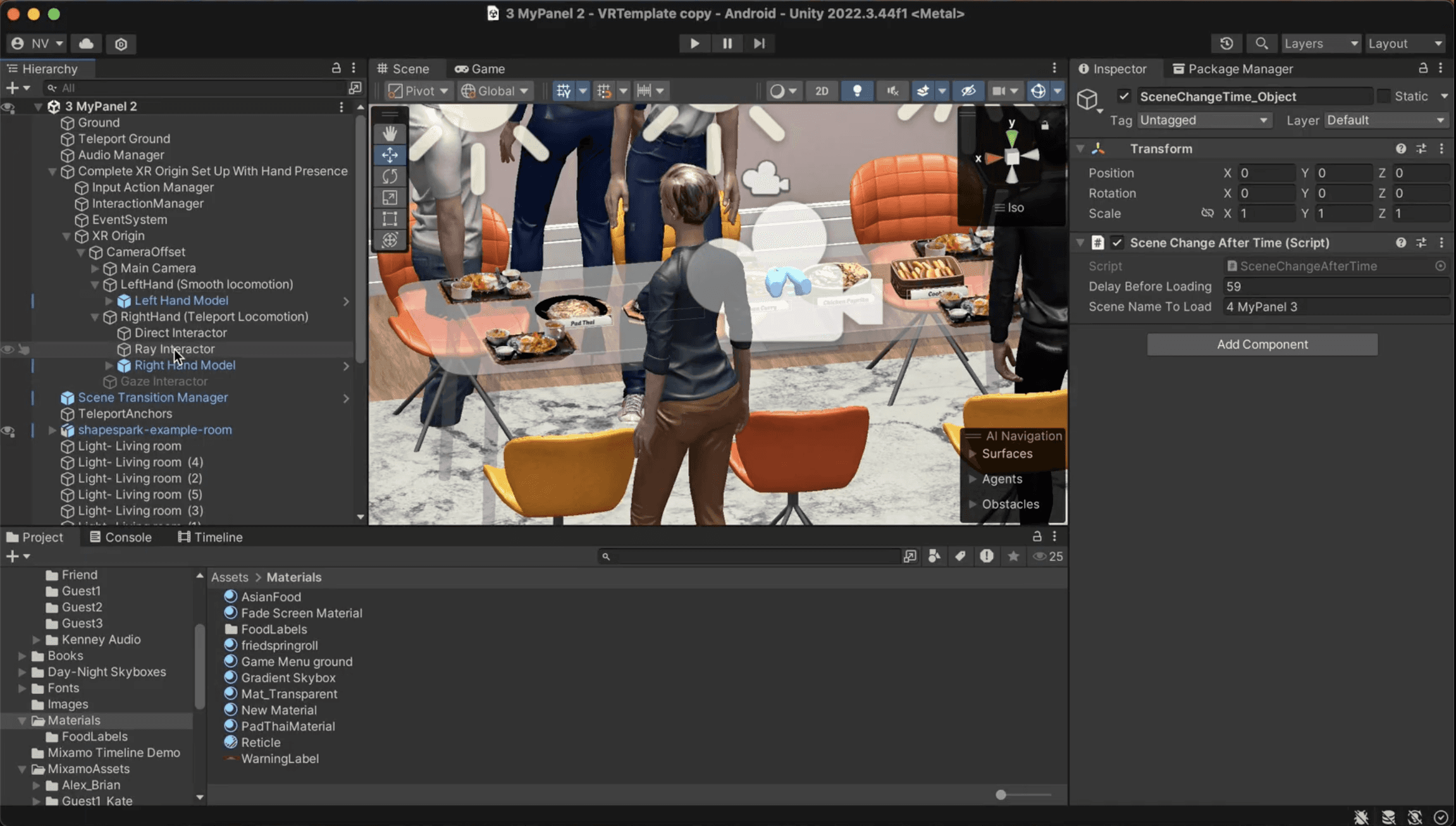
Unity hierarchy showing the Ray Interactor under RightHand in the XR Origin, the raycast source used for hover detection across the dining table.
The real lesson here was recognizing when a tool makes a problem harder instead of easier, and knowing when to ask someone who's solved it before.
The real lesson here was recognizing when a tool makes a problem harder instead of easier, and knowing when to ask someone who's solved it before.
The real lesson here was recognizing when a tool makes a problem harder instead of easier, and knowing when to ask someone who's solved it before.
THE CONCLUSION
THE CONCLUSION
Closing the loop with real numbers
Closing the loop with real numbers
Closing the loop with real numbers
The experience closes by stepping the user back into their own perspective, grounding the emotional arc in real statistics and a direct call to action.
The experience closes by stepping the user back into their own perspective, grounding the emotional arc in real statistics and a direct call
to action.
82%
of individuals with food allergies report restricted choices when dining out
82%
of individuals with food allergies report restricted choices when dining out
82%
of individuals with food allergies report restricted choices when dining out
76%
face limitations during special occasions because of their allergy
76%
face limitations during special occasions because of their allergy
76%
face limitations during special occasions because of their allergy
The closing message: respect dietary needs, ask about allergies, provide safe options, avoid judgment. Empathy begins with understanding.
The closing message: respect dietary needs, ask about allergies, provide safe options, avoid judgment. Empathy begins with understanding.
The closing message: respect dietary needs, ask about allergies, provide safe options, avoid judgment. Empathy begins with understanding.
REFLECTION
REFLECTION
What I'd carry forward
What I'd carry forward
What I'd carry forward
The strongest decision was testing the embodied condition with real people before building it, and changing course when the empathy gap stayed open.
The experience closes by stepping the user back into their own perspective, grounding the emotional arc in real statistics and a direct call
to action.
The strongest decision was testing the embodied condition with real people before building it, and changing course when the empathy gap stayed open.
Test the premise before the prototype.
The lactose-to-peanut pivot happened at the storyboard stage, the cheapest point to learn it wasn't landing.
Catching it that early is what made the pivot cheap.
Know when a tool is the obstacle.
ChatGPT kept adding scripting complexity to a problem with a simple built-in solution.
Asking for help saved the project from over-engineering.
Validate the empathy outcome.
I never formally tested whether the experience measurably increased empathy.
The next version needs a real pre- and post-test in place of that assumption.
Test the premise before the prototype.
The lactose-to-peanut pivot happened at the
storyboard stage, the cheapest point to learn it
wasn't landing. Catching it that early is what
made the pivot cheap.
Know when a tool is the obstacle.
ChatGPT kept adding scripting complexity to a
problem with a simple built-in solution. Asking
for help saved the project from over-
engineering.
Validate the empathy outcome.
I never formally tested whether the experience
measurably increased empathy. The next
version needs a real pre- and post-test in place
of that assumption.
The lactose-to-peanut pivot happened at the storyboard stage, the cheapest point to learn it wasn't
landing. Catching it that early is what made the pivot cheap.
Know when a tool is the obstacle.
ChatGPT kept adding scripting complexity to a problem with a simple built-in solution.
Asking for help saved the project from over-engineering.
Validate the empathy outcome.
I never formally tested whether the experience measurably increased empathy.
The next version needs a real pre- and post-test in place of that assumption.
This project started as something deeply personal, then became something built for someone else entirely. Recognizing that shift, and choosing the version that would actually move another person, is the decision the whole project rests on.
This project started as something deeply personal, then became something built for someone else entirely. Recognizing that shift, and choosing the version that would actually move another person, is the decision the whole project rests on.